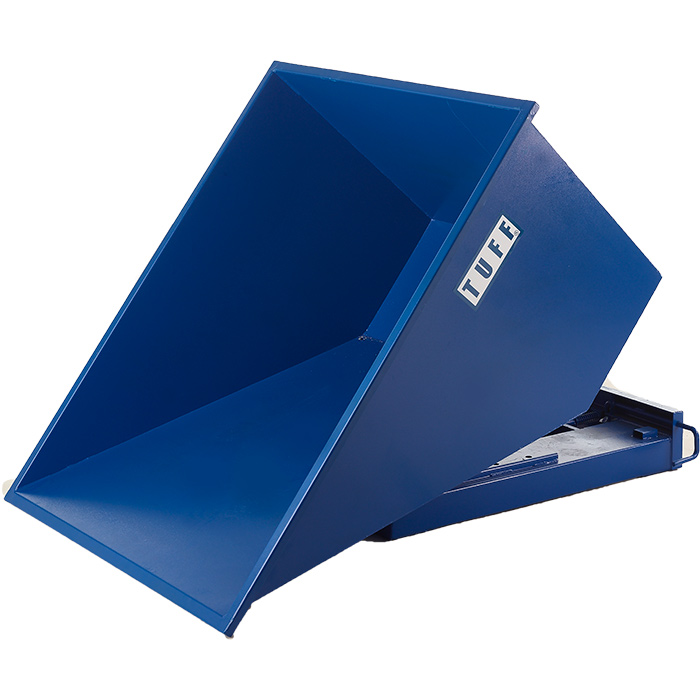
Pallets moved per hour, order correctness, and the smooth movement of goods from receipt to dispatch are common metrics used to gauge efficiency in the busy setting of a contemporary warehouse. However, the management of waste, junk, and loose materials is a recurring issue that is sometimes overlooked beneath the surface of these measures. The debris from everyday activities builds up quickly, ranging from cardboard scraps and plastic strapping to metal shavings and shattered pallet wood. Manual handling has been the norm for years, with employees bending, lifting, and transporting rubbish to central bins or depending on heavy, stationary containers that impede traffic flow. However, a forklift tipping skip is a more safer, more efficient, and more productive alternative. Here are some reasons why your business really needs this modest piece of equipment, which has the potential to completely transform the way your warehouse handles garbage.
Without a doubt, worker safety is the main justification for using a forklift tipping skip. One of the main reasons for musculoskeletal injuries in warehouses is the manual handling of garbage. Every time an employee lifts a big bag of junk or stoops to pick up a pile of cardboard, they run the danger of hurting their knees, shoulders, or back. This risk is completely eliminated with a forklift tipping skip. The skip is made to be lifted, moved, and emptied by a forklift truck rather than using human strength. All the operator has to do is drive the skip to a collection spot, operate the skip, and place the prongs. Without the need for human involvement, the contents may be dumped cleanly into a bigger skip or compactor thanks to the tipping mechanism, which is frequently hydraulic or gravity-assisted. A forklift tipping skip significantly lowers the risk of harm by eliminating the need for employees to handle debris directly, which lowers your accident statistics and related insurance costs. It is a direct investment in your employees’ long-term well-being.
A forklift tipping skip offers significant increases in operating efficiency in addition to the immediate safety advantages. Think about a typical warehouse layout: racking is high, aisles are tight, and every square metre of floor space is valuable. Conventional static rubbish containers take up valuable space and can result in diversions or bottlenecks in busy locations for forklift drivers. On the other hand, a forklift tipping skip is small and portable. It can be kept in a specific bay within a racking system, in a corner, or beneath a mezzanine. A forklift just scoops it up and moves it to the central garbage area when it is full. As a result, garbage collection is no longer a distinct, disruptive duty but rather a smooth element of the forklift’s daily operation. There is a significant time savings. The forklift driver may combine rubbish as it passes through the warehouse rather than a worker going to a bin, filling it, and then waiting for a different pickup. Your staff can concentrate on key value-adding tasks thanks to this integrated workflow, which also maintains the floor free and lessens traffic congestion.
Additionally, a forklift tipping skip’s adaptability makes it appropriate for a variety of materials. A sturdy skip can manage the weight whether your warehouse handles heavier, more abrasive commodities like metal waste or construction debris, or dry recyclables like paper and plastic. Many types have sturdy tipping mechanisms and reinforced sidewalls to endure everyday usage. Because of its versatility, you are buying a versatile asset that can be used by several departments rather than a single-purpose instrument. For example, a maintenance workshop can use the same skip for metal offcuts, while a packing station can utilise it for cardboard debris. The forklift tipping skip is crucial because it creates a uniform, predictable system that is simple for all employees to understand and adhere to by standardising the waste handling procedure throughout your whole operation.
The increase in workplace cleanliness and organization is another important aspect. A messy warehouse poses a risk in addition to being unsightly. Falls, stumbles, and slides can result from loose trash on the ground. Additionally, it may entangle itself in moving gear or harm forklift tires. A forklift tipping skip promotes a cleaning culture by offering a specific, portable garbage container. When a handy, forklift-accessible skip is close by, operators and pickers are more likely to appropriately dispose of rubbish. This results in a more organised workplace, which boosts morale and output. Additionally, a clean warehouse makes it simpler to audit and inspect, which helps you stay in compliance with health and safety laws. Having a forklift tipping skip shows both staff and guests that your company values order and safety.
A forklift tipping skip has a strong financial return on investment. In comparison to the continuous savings, the initial purchase price is rather low. Lower insurance rates and reduced downtime from worker absences result from fewer injury claims. Improved efficiency reduces the amount of time needed to handle trash, freeing up workers for more productive jobs. Additionally, you may be able to cut your trash disposal expenses by reducing the frequency of garbage collections from outside contractors through more efficient waste consolidation. Additionally, several warehouses discover that employing a forklift tipping skip increases recycling rates since items are kept apart and uncontaminated, potentially earning money from recyclable goods. To put it briefly, this is a piece of equipment that generates observable, quantifiable savings.
The ergonomic advantages for your forklift drivers should also be taken into account. Forklift operation is already a difficult profession that calls for continual attention to detail. Unnecessary physical effort and mental stress are added when bulky garbage bins must be physically tipped or dragged. The purpose of a forklift tipping skip is to cooperate with the truck. Without ever getting out of the cab, the driver may pick up, move, and empty the skip. This lessens fatigue and enables the driver to handle garbage in a safe, sitting position. As a result, the operator is less likely to make mistakes or create accidents since they are more focused and less agitated. Adding a forklift tipping skip to your collection of attachments is a modest but effective way to improve ergonomics.
Additionally, the general workflow architecture of your warehouse may benefit from the installation of a forklift tipping skip. Waste management is frequently overlooked while designing a new facility or rearranging an existing one. You may strategically place garbage collection spots close to high-waste-generating locations, such packing stations, production lines, or receiving ports, by integrating mobile skips into your strategy. Waste will never become a bottleneck thanks to our proactive strategy. Instead of being a static barrier, the forklift tipping skip becomes a dynamic component of your logistics, moving with the flow of activity. It is challenging to get this degree of integration with manual collecting techniques or permanent containers.
Lastly, it’s critical to understand that a forklift tipping skip isn’t limited to enormous warehouses. Small and medium-sized businesses stand to gain equally. Every square metre matters in a smaller location, making the capacity to transport trash swiftly and effectively even more crucial. A small skip may be kept in a little amount of space and manoeuvred through narrow passageways. Regardless of the size of your business, the concepts of efficiency, safety, and cleanliness are applicable. A forklift tipping skip provides a scalable, useful solution whether you are a tiny industrial facility making scrap metal or a distribution center managing thousands of pallets per day.
In conclusion, there is a strong argument for including a forklift tipping skip into your warehouse operations. It tackles the core issues of cost reduction, efficiency, safety, and organization. It safeguards your most precious asset—your people—by doing away with human handling. It increases productivity and decreases downtime by simplifying garbage collection. Maintaining a clean facility improves morale and compliance. It also makes good financial sense because it yields a high return on investment. This straightforward yet revolutionary piece of technology is too important for the modern warehouse to ignore. Now is the moment to take action if you haven’t already thought about how a forklift tipping skip may enhance your day-to-day operations. Your bottom line, your budget, and your employees will all appreciate it.