Traditional approaches to financial management are quickly becoming irrelevant in the dynamic world of contemporary company management. Organisations now have a more flexible, safe, and efficient option than software that is limited to desktop computers thanks to cloud accounting, which has completely changed the laws of financial management. Businesses in the UK used local hard drives and paper trails to keep track of money coming in and going out for a long time. Financial reporting was frequently delayed, human error was common, and agility was severely lacking due to this antiquated method. With the advent of cloud accounting, businesses can now run in real time, turning the finance department into a strategic asset that can look ahead instead of backward.
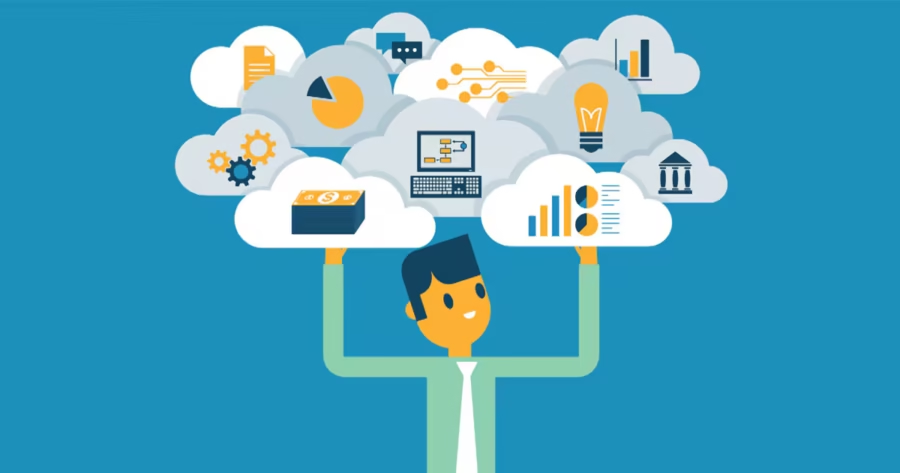
One must first understand the basic operation of cloud accounting in order to completely comprehend this digital revolution. Rather from being installed on a single desktop computer, cloud accounting is run fully on remote servers that are hosted via the internet. What this implies is that approved individuals may access vital financial data from anywhere with an internet connection because it is processed and kept securely online. Business owners and finance teams may free themselves from the constraints of a traditional office setting by adopting cloud accounting. Constant and unbroken financial supervision is possible via a secure gateway, regardless of location (working from home, commuting, or visiting a customer).
The world of finance is always changing, and any delay in receiving information may have a devastating effect on a rapidly expanding business. A major perk of cloud accounting is the ability to broadcast data in real-time. Historically, owners of businesses were required to hold up on receiving updated balances and profit statements until the end of each month or even the financial quarter. As soon as a transaction, invoice, or expenditure occurs, all of them are immediately updated using cloud accounting. The ability to see and fix cash flow issues before they endanger the company’s future is a direct result of this immediacy, which allows management to make educated decisions based on current facts instead of historical conjecture.
Additionally, cloud accounting allows for a hitherto unseen degree of cooperation between companies and their financial advisers. In the past, sending accountants financial data required exporting large files, storing them on external devices, or even mailing real receipts in bundles. Because several users may access the same ledger at the same time via cloud accounting, this administrative load is entirely removed. While a company owner in London examines one invoice, an accountant in Edinburgh examines another, and they may debate the tax consequences in real time. By revolutionising yearly compliance checks into a proactive partnership, this seamless connectivity elevates the advisor-client relationship.
Organisations entrusted with sensitive financial data understandably prioritise security, an area where cloud accounting provides strong solutions. At first, many company owners are wary about keeping financial data online because of the potential security risks. On the other hand, trustworthy cloud accounting systems devote a lot of money into advanced security features like multi-factor authentication and bank-grade encryption, which are much better than what a regular office PC can do. A company that uses old-fashioned desktop software runs the risk of losing all of its financial records in the event that a laptop is stolen, burnt, or destroyed. On the flip side, businesses that use cloud accounting never lose any data because everything is saved digitally and can be viewed from anytime, anywhere.
One of the main reasons why cloud accounting is so important for current efficiency is because of automation. In addition to being a tedious and error-prone process, manual data entry might lead to missing transactions or decimals. Businesses may streamline a plethora of mundane processes using cloud accounting, including daily bank feed imports, statement reconciliation, and the generation of recurring invoices. Cloud accounting frees up the financial staff to concentrate on more valuable tasks like analysing market trends, optimising budgets, and preparing for future expansions by eliminating the hours spent on monotonous data input.
Cloud accounting gracefully handles the common administrative burden of chasing delinquent bills. In the world of small and medium-sized businesses, where profit margins are razor-thin, late payments are one of the biggest killers. Luckily, customers may set up automated reminders from their cloud accounting system when payment dates are missed, and the system can also keep track of outstanding bills. The company can keep a strong cash buffer thanks to this methodical technique, which enhances cash flow significantly without making employees waste time writing uncomfortable letters.
When it comes to regulatory compliance, especially in the UK, cloud accounting is just as important as operational efficiency. Businesses must now keep digital records and file their tax returns using software that is compatible with the ever-increasing digitisation of tax systems. One certain way for a business to stay in line with these ever-changing rules is to switch to cloud accounting. Business owners can rest easy knowing that they are always functioning inside the right legal framework thanks to the fact that cloud accounting platforms are automatically updated by their developers to reflect the most recent tax legislation, rates, and thresholds.
One of the main reasons why ambitious, forward-thinking businesses are drawn to cloud accounting is its scalability. The financial complexity of a growing company need more sophisticated reporting, the ability to handle several currencies, and greater user access. Conventional software frequently necessitates the acquisition of costly updates or new systems by expanding businesses. Increasing capacity with cloud accounting is as easy as changing a digital subscription plan. No changes to day-to-day financial procedures are necessary since the software expands gracefully with the company, supporting higher transaction volumes and more intricate operational structures.
Cloud accounting helps achieve sustainability objectives by reducing the negative effects of company operations on the environment, which is a growing concern in the corporate sector. With cloud accounting, all financial activities are moved to the digital realm, which means less need for paper, file cabinets, and printing supplies. Rather than using printed booklets, invoices are transmitted online, receipts are scanned and saved digitally, and financial reports are exchanged over secure connections. By cutting down on paper use, the company may improve its corporate social responsibility image while cutting costs and becoming more in line with current eco-friendly practices.
In addition, cloud accounting’s integration options cover a lot more ground than just simple bookkeeping. Various digital technologies are utilised by modern organisations for the management of operations. These tools include inventory systems, point-of-sale terminals, and payroll software. Accounting in the cloud serves as the nerve center of this ecosystem, facilitating the seamless interaction of various applications. With every purchase made at the register, the cloud accounting system immediately updates the stock, updates the customer information, and logs the money. This all-encompassing interconnectedness breaks down data silos, giving a bird’s-eye perspective of the company’s operations.
You can’t discount the mental health benefits of switching to cloud accounting. There is a lot of pressure on entrepreneurs to succeed, and they often worry about making ends meet because of the weight of responsibility that comes with running a business. Owners may rest easy knowing they can access their financial information at any time because to cloud accounting’s transparency. You can’t have control and confidence when you depend on old, jumbled financial records; knowing the precise amount in the bank, who owes what, and when payments are due gives you that control and organization.
Looking ahead, it’s clear that digital transformation is going to pick up speed. Already, cloud accounting systems are incorporating AI and ML, which could lead to even better automated decision-making and predictive analysis. Companies who don’t use cloud accounting run the danger of slipping far behind the competition, mired in manual methods that are both time-consuming and inefficient. These days, no British company can afford to ignore the imperative of investing in cloud accounting if they want to survive, thrive, and make a profit in the modern economy.
Last but not least, cloud accounting is a game-changer when it comes to financial management technology. The way companies handle their financial data is revolutionised by cloud accounting, which combines accessibility, real-time data visibility, increased security, and strong automation. It facilitates communication between company owners and accountants, streamlines compliance with regulations, and offers scalability to support expansion plans. Embracing cloud accounting and shedding the limitations of old approaches is a game-changer for operational excellence. It equips businesses to succeed in our digital age.