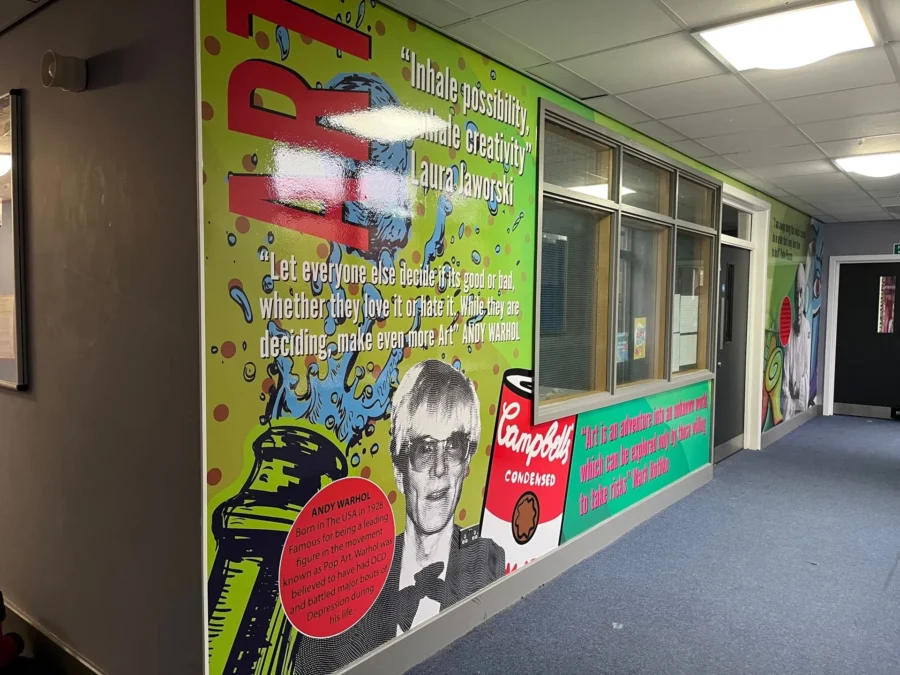
A visitor’s initial impression of a school could be influenced by the visual presentation of the room upon entering. The importance of school wall art in establishing engaging, motivating, and meaningful environments that promote learning, motivation, and wellness is being acknowledged by an increasing number of educational institutions. Good school wall art is more than simply decoration; it’s an integral component of school spirit, a way to communicate ideals, and a way to bring the school community together.
The artwork displayed on school walls significantly influences the ambiance of a learning environment. The walls of classrooms, hallways, libraries, and common spaces offer an empty surface that, with imagination, may entirely alter the ambiance of a school. Wall art is a great way to visually convey important messages that students will see every day, whether they are encouraging pictures that encourage optimism or informative information that complements the curriculum.
The capacity of school wall art to portray the principles and culture of a school is one of its most significant advantages. Many educational institutions opt to exhibit their fundamental values—such as perseverance, creativity, community, and respect—with large-format designs that are put on display in common spaces or halls. Positive conduct is encouraged and a unified school culture is fostered by these visible reminders. When presented in a vibrant and interesting way, visual signals help children learn and become ingrained in their daily routines.
School wall art serves as more than just a moral reminder; it may also be an effective teaching tool. Academic disciplines such as mathematics, history, geography, and science can benefit greatly from visually appealing and instructive information. Displays like a solar system in a science corridor or a chronology of British history in a humanities block might help students remember and apply what they’ve learnt in class. Schools may broaden their students’ learning experiences outside the classroom by displaying instructional information on the walls, rather than only in textbooks.
Students’ emotions and actions are heavily influenced by the visual surroundings. Bright, vibrant, and well designed spaces may boost and invigorate, whereas dull or unappealing ones might depress motivation. School wall art has the power to transform a space into one that is inviting, safe, and intellectually engaging. Students with special needs or younger students may be more attuned to their surroundings, therefore this is extra crucial for them. Having visually consistent areas with common themes helps reassure students and make it easier for them to find their way about the school.
Additionally, school wall art has the potential to promote diversity and inclusion. For all students to feel included and appreciated, classroom imagery should represent the cultural, gender, and ability diversity of the student body. Including content in many languages, celebrating other cultures, or highlighting great personalities from diverse backgrounds may all help to create a more inclusive atmosphere. Students’ sense of self-worth and community might benefit from environments that mirror their own characteristics.
School wall painting is a common way for elementary schools to encourage students’ interest and creativity. Nature, space, or the jungle are just a few examples of possible themes for spaces, which may transform boring hallways into exciting adventures in learning. Interactive components like counting games, shapes, or word challenges might be used in murals and visuals. Particularly for students in the early grades who learn best via visual and tactile experiences, these elements aid in the embedding of knowledge through repetition and engagement.
School wall art at secondary schools may have a slightly different tone, with a greater focus on academic achievement, ambition, and drive. To encourage older students to think critically and creatively, teachers might use quotations from famous thinkers, difficulties related to the students’ subjects, or possible career paths as teaching tools. The utilisation of wall space for subject departments to showcase accomplishments, projects, or important information can help to instill a feeling of pride and purpose in their learning path.
Wall art may also be a great addition to staff spaces. Staffrooms may be transformed into more cheerful spaces by displaying upbeat messaging, wellness themes, or school vision statements. Everyone in the school community, from teachers and kids to parents and visitors, can rally around a common identity with the aid of visual branding and consistent messaging.
Aesthetics and function must be carefully considered when designing functional classroom wall art. Aesthetics aside, it has to have a purpose and be current. Factors such as age-appropriateness, typography, colour theory, and spatial arrangement are crucial. Minimalist designs risk losing the chance to interact, whereas chaotic or distracting designs might have the opposite effect. When creating wall art for schools, it’s important to keep the target audience (kids and teens) in mind and make sure it complements the school’s personality.
Wall art should be chosen with care to ensure it lasts a long time and requires minimal upkeep in schools. The materials utilised should have the ability to endure heavy foot traffic, be simple to clean, and maintain their colour vibrancy as time goes on. The durability and ease of use of printed vinyl, direct-to-wall paint, and panel systems make them popular choices. A school’s dedication to sustainability may be seen by its use of durable and environmentally conscious materials.
Supporting emotional literacy and mental health through wall art is another emerging trend. Decorate peaceful areas, wellness zones, and sensory rooms with soothing hues, images of nature, and words that encourage contemplation and rest. These pieces are more than simply decoration—they’re part of a bigger support plan in today’s educational atmosphere, which prioritises students’ emotional well-being.
Participation from kids in the making of classroom murals is another worthwhile endeavour. Students can feel like they have a stake in their school and its aesthetic by participating in group art projects, creating their own mural designs, or submitting quotes to use as school quotes. A sense of accomplishment and pride is fostered, and engagement is increased, as a result. Students are more likely to take ownership of the places they frequent when they have a say in making those places what they are.
Additionally, school wall art can improve the building’s navigation and transitions. Students experience less anxiety and more autonomy as a result of the school’s colour-coded zones, themed sections, and uniform signage. Students who are new to school or who have special needs may benefit greatly from this visual aid, which may help them feel more at ease and confident.
School branding is greatly influenced by wall art. To outside parties like parents, governors, inspectors, and potential families, it conveys the school’s identity, values, and aims. Care, quality, and ambition are strongly conveyed in a setting that is aesthetically consistent and presented professionally. Additionally, it might serve as a unique selling feature for schools in highly competitive education marketplaces.
The learning environment is the ultimate beneficiary of school wall art investments. Although wall art cannot improve academic performance on its own, it does help create an environment that is conducive to learning, positive behaviour, and overall health, all of which are important components of a well-rounded education. It shows kids that their school is a proud and inspiring environment where they may study and grow, and that their personal space is valuable.
Finally, murals on school walls are about so much more than just making a statement. Strategically, it may be used for educating, communicating, and providing emotional support. It provides an opportunity for schools to turn unused or boring areas into valuable resources while also promoting values, learning, diversity, and wellness. School wall art has several uses in today’s classrooms, including enhancing students’ understanding of the material, inspiring them to reach for the stars, and fostering a more accepting and inclusive atmosphere. Not only does it leave an indelible mark on the walls, but it also stays with the pupils that pass by them on a daily basis.